

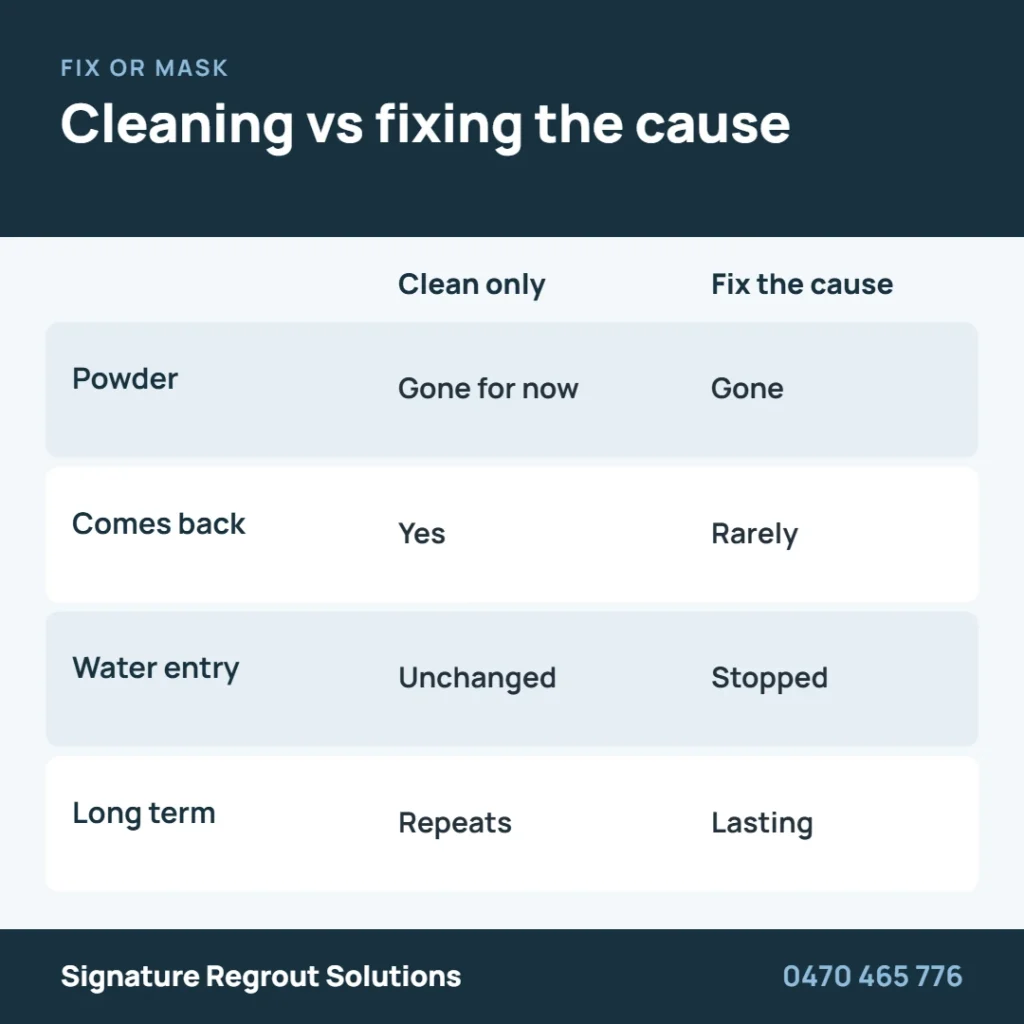
You sweep the balcony, and a week later the white powder is back on the grout and tile edges. That's efflorescence. Efflorescence is a white, salty deposit left behind when water moves through grout, mortar or concrete and evaporates at the surface. It's a sign that water is getting into the tiled area, so cleaning it off only treats the symptom.
Here's what causes efflorescence, why it keeps coming back, and how to stop it properly.

Seeing white powder on your tiles?
Send us a photo on WhatsApp and we'll tell you what it points to.
What Causes Efflorescence?
Efflorescence needs three things: salts in the materials, water to dissolve them, and a path for that water to reach the surface. Cement-based grout, mortar beds and concrete slabs all contain salts. When water gets in through cracked grout, gaps at the edges or a failing membrane, it dissolves those salts. As the water evaporates in sun and wind, the salts are left behind as white powder or crust.
It's most common on balconies, terraces, outdoor steps and around pools, where tiles get rain and then dry quickly.

Is Efflorescence a Problem?
On its own, efflorescence is mostly cosmetic. What it tells you is the real issue: water is moving through the tiled area. On a balcony over a living space, that same water can lead to leaks into the room or unit below. Our guide to why balconies leak explains the link.
Ongoing efflorescence can also break down grout over time and leave tiles looking permanently dull.

How to Clean Efflorescence
For a light deposit:
- Brush the dry powder off with a stiff brush.
- Rinse with clean water and let it dry.
- For heavier deposits, use a product made for efflorescence, following the label carefully.
Be careful with strong acids. They can etch some tiles and damage cement grout, and they don't stop the efflorescence coming back.
Want the cause of the efflorescence fixed?
We'll check the grout, silicone and drainage and give you a clear quote.
How to Stop Efflorescence Coming Back
Stop the water getting in. That usually means:
- Regrouting cracked or porous grout, often with epoxy grout outdoors because it barely absorbs water.
- Resealing the joints where tiles meet walls, door frames and balustrades.
- Clearing drains so water runs off instead of pooling.
- Checking the fall of the surface so water doesn't sit on the tiles.
If the membrane under the tiles has failed, a bigger repair is needed. The Building and Plumbing Commission explains how waterproofing is meant to work. Our balcony regrouting page shows how we fix grout and silicone on outdoor tiles.
Efflorescence in Showers
It's less common indoors, but you can see these salt deposits on shower grout, especially on older cement grout or where water sits for long periods. It's a sign the grout is absorbing a lot of water. Regrouting with epoxy usually solves it. Our guide on whether epoxy grout is worth it explains why.
At Signature Regrout Solutions, we treat the white powder as a clue rather than the problem itself. Find where the water is getting in, fix that, and the white powder stops.
Where to Look on a Balcony
Check the grout lines closest to the door sill, the edges along the walls and the area around balustrade posts first. These are the joints that move most and crack first. Look at the drain too. If water pools near it after rain, the fall may be wrong or the outlet partly blocked.
A quick test is to hose a small area and watch where water sits and how quickly the grout darkens. Joints that soak water up fast are the ones letting it in.
New Tiles With White Powder
Freshly laid tiles can show some white powder in the first weeks as the materials dry out. This often fades with gentle cleaning. If it keeps returning months later, water is getting in from somewhere.
Quick Questions
Will efflorescence go away on its own?
Sometimes on new work as it dries out. If it keeps returning, water is getting in.
Can I seal over efflorescence?
Not until it's cleaned off and the cause is fixed, or the sealer can trap moisture.
Is efflorescence the same as mould?
No. It is salt, usually white and powdery. Mould is a living growth, often black or green.
The Bottom Line
The white powder is a warning sign that water is moving through your tiles. Clean it off, then fix the grout, silicone or drainage so it stops for good.
White powder keeps coming back?
Send a photo on WhatsApp or give us a call. We'll help you find where the water is getting in.